
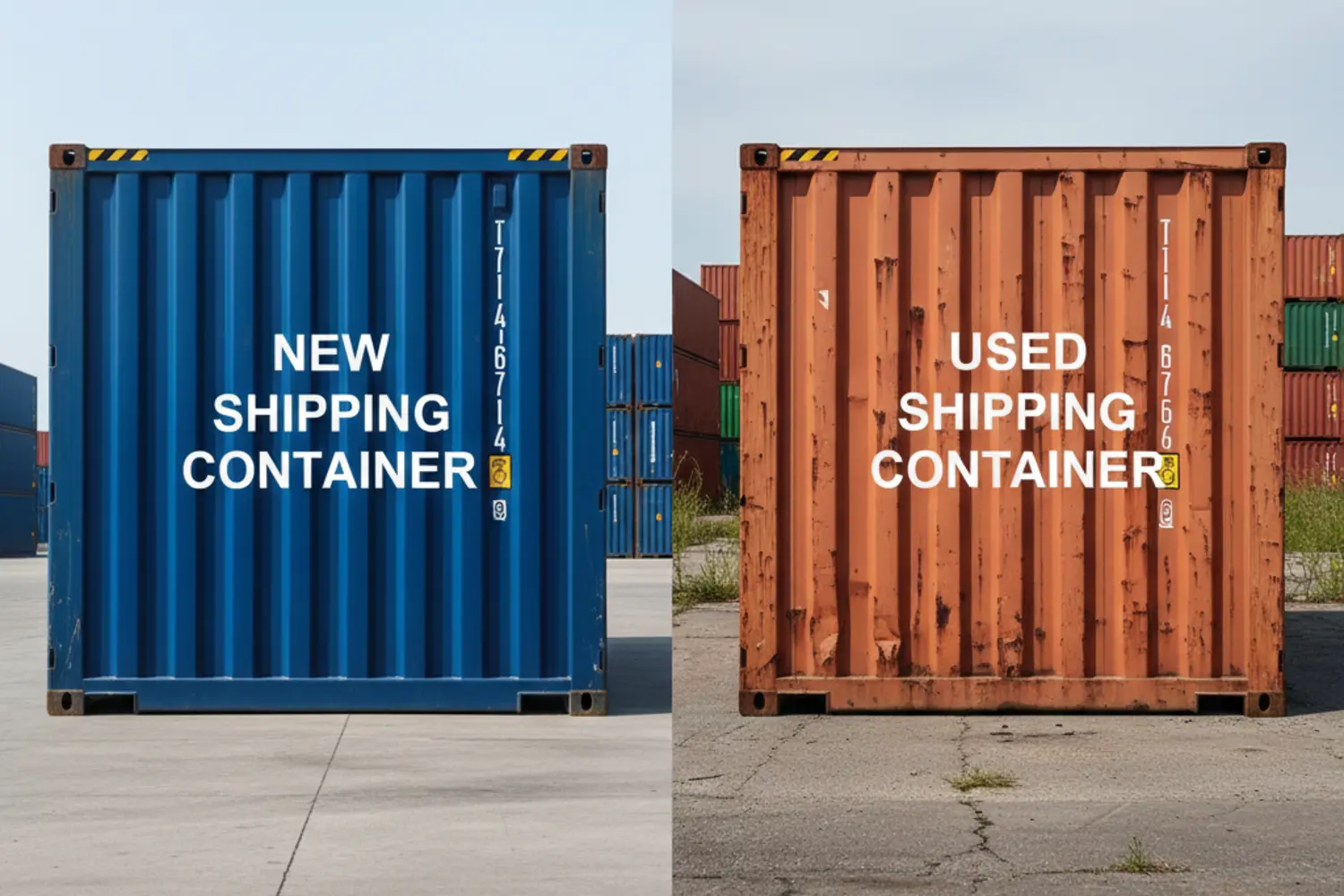
At first glance, the decision between new and used shipping containers looks purely financial. One costs more, the other costs less. But in practice, this choice is about expectations—how the container will be used, how long it needs to last, and how much cosmetic or structural imperfection you’re willing to accept.
New containers promise predictability. Used containers offer value. Neither option is automatically better, and many disappointments come from choosing based on price alone. This guide explains the real differences between new and used containers, how shipping container grades work, what condition actually means in day-to-day use, and how cost should be evaluated realistically.
Understanding the Difference Between New and Used Shipping Containers
The term “new” in the container world can be misleading. Most new shipping containers are technically one-trip shipping containers—units that have made a single overseas journey carrying cargo before being sold. They are functionally new but not factory-fresh in the strictest sense.
Used shipping containers, on the other hand, have spent years in active service. They’ve been loaded, stacked, lifted, exposed to salt air, and moved across ports. Their value lies not in appearance, but in continued structural usability.
The key difference is not age alone, but predictability. New containers offer consistency. Used containers offer variation.
What Are Shipping Container Grades?
Container grades exist to set expectations—not guarantees. They describe general condition, not exact appearance.
Understanding shipping container grades helps buyers compare options without assuming perfection where none exists.
Common Shipping Container Grades Explained
While terminology can vary by dealer, most containers fall into a few recognizable categories.
One-Trip Shipping Containers
These are the closest thing to new on the market. One-trip units typically show minimal wear—small dents or scuffs from their first journey—but are otherwise clean and uniform.
They are often chosen for projects where appearance matters, such as offices, retail conversions, or residential use.
Cargo-Worthy (CW) Containers
Cargo-worthy containers are structurally sound and certified for transport. They are wind- and water-tight, but cosmetic wear is expected.
These units may show dents, surface rust, or patched areas, but they remain fully functional for storage and shipping.
Wind and Water Tight (WWT) Containers
WWT containers are not certified for shipping but are sealed against the elements. They are commonly used for on-site storage.
Appearance varies widely, but floors, doors, and roofs remain functional.
As-Is Containers
As-is containers are the lowest grade. They may have leaks, damaged doors, or structural issues. These are typically purchased for parts, heavy modification, or non-critical uses.
What Condition Actually Means in Real Use
Condition is often misunderstood as appearance. In practice, condition affects usability more than looks.
A heavily dented container can still be perfectly usable for storage. A container with door alignment issues, however, can become a daily frustration. Floors matter more than paint. Doors matter more than dents.
When evaluating used conex containers, buyers should focus on function first, aesthetics second.
What to Inspect Before Buying Used Shipping Containers
Inspection matters more with used units than with new ones. Even containers in the same grade can vary significantly.
Key things to check include:
- Door operation and seal integrity
- Floor condition, especially near door thresholds
- Roof flatness and signs of sagging
- Rust around corner posts and welds
Cosmetic imperfections are normal. Functional problems are not.
Cost Differences: New vs Used Shipping Container Prices
Price is where the gap becomes most visible.
Used shipping container prices are significantly lower than new or one-trip units. However, lower price should be weighed against lifespan expectations and intended use.
New containers cost more upfront but often require less immediate maintenance. Used containers save money initially but may need repairs sooner, depending on condition.
The right choice depends on duration, not just budget.
When New Shipping Containers Make More Sense
New or one-trip containers are often the better option when:
- Appearance matters
- Long-term use is planned
- Modifications are extensive
- Predictable condition is required
They reduce uncertainty and are easier to work with for design-focused projects.
When Used Shipping Containers Are the Smarter Choice
Used shipping containers are ideal when:
- Budget is a primary concern
- Containers are used for storage, not display
- Cosmetic wear is acceptable
- Deployment needs to scale quickly
For construction sites, industrial storage, or temporary use, used containers often deliver the best value.
The Real Trade-Off: Cost vs Certainty
Choosing between new and used containers is less about right or wrong and more about tolerance for variability.
New containers offer certainty at a premium. Used containers offer savings with trade-offs. Problems arise when buyers expect new-condition performance from used units—or overpay for new containers when their use case doesn’t require it.
Used Conex Containers in Long-Term Projects
Used conex containers are frequently used in long-term projects without issue. Steel containers are built to last, and many continue to perform reliably decades into service.
What matters is not age, but how the container was handled and maintained. A well-kept used unit often outperforms a poorly stored newer one.
Budgeting Beyond the Purchase Price
The purchase price is only part of the equation.
Additional costs may include:
- Delivery and placement
- Minor repairs or sealing
- Locking systems or security upgrades
- Cleaning or repainting
These costs are usually modest but should be planned for—especially with used units.
Matching Container Condition to Project Type
The best container choice aligns condition with purpose.
A construction site does not need pristine paint. A pop-up retail space probably does. Storage behind a warehouse values function over form. Customer-facing applications do not.
Buying the “best” container is not the goal. Buying the right container is.
Common Mistakes Buyers Make
Many issues stem from mismatched expectations:
- Choosing used containers for appearance-driven projects
- Overpaying for new containers for basic storage
- Ignoring floor and door condition
- Assuming grades guarantee uniform quality
Clear expectations prevent disappointment more effectively than any grade label.
How Container Age Affects Maintenance and Longevity
One of the least discussed differences between new and used shipping containers is how age influences ongoing maintenance. While steel containers are designed for long service life, years of exposure to salt air, heavy stacking, and repeated handling inevitably leave traces.
Older containers may require periodic attention—resealing doors, treating surface rust, or reinforcing flooring in high-traffic areas. None of these are dealbreakers, but they do shift responsibility to the buyer. New or one-trip shipping containers, by contrast, offer a longer “hands-off” period before maintenance becomes part of ownership. The question is not whether maintenance will be needed, but when and how much tolerance you have for it.
How Location and Climate Influence the Right Choice
Geography quietly shapes whether new or used containers perform better over time. In dry, inland environments, used conex containers often last for years with minimal intervention. In coastal or high-humidity regions, corrosion accelerates, and container condition matters more from day one.
For projects in harsh climates, starting with a newer unit can reduce long-term headaches. In more forgiving environments, used containers deliver excellent value with little downside. Climate does not change container quality—but it amplifies its weaknesses. Matching condition to environment is often more important than matching condition to budget.
Condition Should Serve the Use Case
The choice between used shipping containers and new units is not about good versus bad—it’s about alignment.
New containers offer consistency, cleaner aesthetics, and longer predictable lifespans. Used containers offer affordability, durability, and practicality when appearance is secondary.
When container condition matches project needs, both options make sense. Problems arise only when expectations and reality drift apart. Choose based on how the container will actually be used, not how perfect it looks on delivery day.