
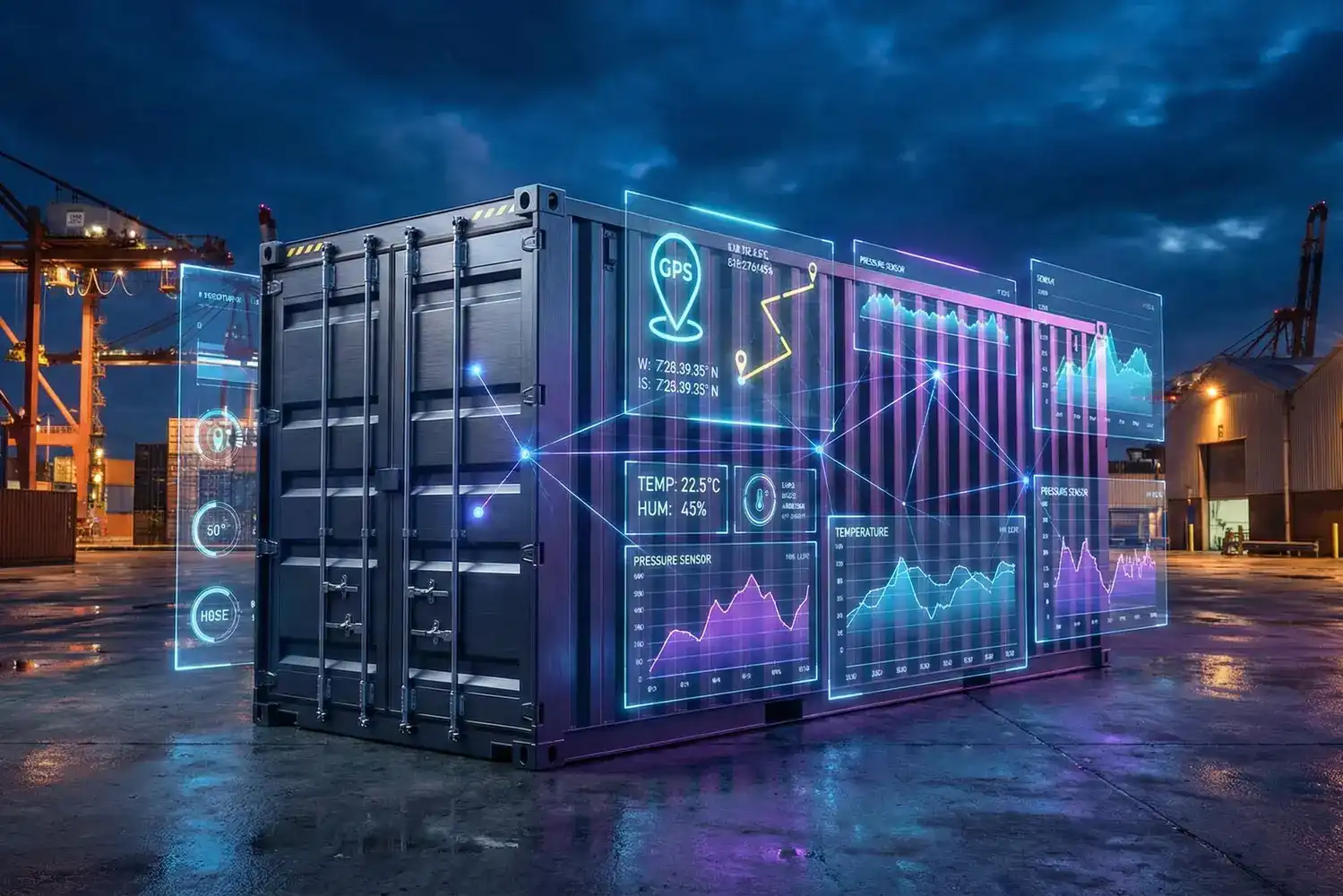
Containerized infrastructure is evolving faster than most people realize. What was once a simple steel box for storing freight is now a digitally enhanced asset capable of sharing real-time location data, temperature readings, internal conditions, and security alerts. Powered by IoT hardware, cloud platforms, and automation tools, smart container technology is transforming logistics visibility and giving businesses a more accurate view of their supply chain operations.
These technological add-ons aren’t merely upgrades. They are becoming necessary for companies managing time-sensitive goods, high-value inventory, or distributed container fleets. By implementing container GPS tracking, environmental sensors, and remote container monitoring solutions, organizations reduce risk, prevent theft, and improve compliance—often with immediate financial payback.
Let’s dive deeper into the ecosystem of smart container technologies, the business case behind them, and the operational advantages of connecting steel to software.
Why Containers Need Intelligence Now
Supply chains have never been more complex. Globalized sourcing, fluctuating demand, unpredictable weather, and increased security concerns push logistics managers to demand more data. Without real-time insight, companies face:
- Missing inventory
- Temperature spoilage
- Unplanned downtime
- Lost assets during transport
- Regulatory compliance issues
Smart add-ons solve these problems not by introducing new processes, but by illuminating blind spots that companies have tolerated for decades.
When a container becomes smart, it stops operating as a passive box. It becomes a node in a digital network.
Container GPS Tracking: Never Lose Sight of Valuable Assets
One of the most widely adopted smart upgrades is container GPS tracking. It attaches to the container like a rugged module and transmits real-time coordinates through cellular, satellite, or hybrid networks. The benefits are immediate:
- Logistics managers see exact positioning, not “somewhere en route.”
- Theft attempts become dramatically harder.
- Delays in transit are visible before customers complain.
- ETA predictions improve significantly.
Tracking also reduces operational guesswork. Instead of dispatching multiple emails or phone calls to confirm where a shipment is, managers simply check a dashboard. When scaled across fleets, this efficiency can save thousands of workforce hours.
Installation is straightforward, and many modern units operate on long-life batteries, solar power, or energy harvesting technologies.
Smart Container Sensors: Data Beyond Location
Location data is powerful, but for many industries, internal container conditions matter even more. Container sensors can monitor and transmit:
- Temperature and humidity
- Shock and vibration levels
- Door events (open/close logs)
- Tilt and movement anomalies
- Gas levels and air quality
This matters in sectors such as:
- Pharmaceuticals
- Electronics
- Food and beverage
- Chemicals
- Fresh produce
- Artwork and museum materials
If humidity rises suddenly, the system alerts operators. If the door opens unexpectedly, security teams receive an immediate notification. If a vibration threshold is crossed, cargo integrity can be assessed before damage spreads to neighboring units.
IoT in Shipping Containers: The “Connected Box” Concept
When applying IoT in shipping containers, sensors, GPS, and gateways send information to cloud dashboards where logistics teams analyze performance patterns. IoT ecosystems also enable:
- Predictive maintenance
- Automated compliance reporting
- Remote troubleshooting
- Condition-based workflows
Instead of waiting for failures, businesses act preemptively.
Imagine receiving a notification that vibration levels on a sensitive equipment shipment have exceeded safe limits. Normally, this damage might go unnoticed until arrival. With IoT signals, teams can intercept, repair, or reroute.
Container intelligence becomes not just reactive—but preventive.
Remote Container Monitoring: Control Regardless of Geography
Smart add-ons are most powerful when paired with remote container monitoring platforms. These systems give operators access to dashboards that update wirelessly, whether the container sits on a cargo ship thousands of miles away or on a storage yard across town.
Remote monitoring typically includes:
- Live sensor readings
- Location history
- Maintenance alerts
- Power usage analytics
- Battery level tracking
- Door access logs
This eliminates blind transit periods. Instead of saying “we’ll know when it arrives,” teams monitor conditions continuously.
Remote oversight also reduces administrative friction—no manual check-ins, fewer status calls, and shorter investigation cycles.
Smart Logistics Containers: Automating the Hard Parts
As supply chain complexity grows, human oversight becomes overwhelmed. By integrating automation into smart logistics containers, companies can:
- Automate arrival notifications
- Trigger alerts when measured conditions diverge from defined ranges
- Document compliance for regulators
- Track handling quality across carriers
This automation reduces disputes. If cargo is mishandled, shock sensors provide proof. If temperature spikes during cold-chain transport, liability becomes measurable.
Data prevents finger-pointing. It restores transparency.
Real-Time Monitoring Containers: Time Is Money
Time-sensitive cargo—such as refrigerated medicine—requires real-time monitoring containers to avoid spoilage. These systems record and broadcast data continuously. When deviations occur:
- Automated alerts notify technicians.
- Mobile apps ping supervisors.
- Shipment rules adjust dynamically.
This real-time component improves decisions such as rerouting trucks to avoid heat or accelerating customs clearance to protect pharmaceuticals.
And because the data stays archived, it can also help during audits.
Security Enhancements: Digital Locks and Door Sensors
Security is one of the strongest arguments for smart add-ons. Containers lose billions in cargo every year due to:
- Unauthorized access
- Tampering
- Internal theft
- Piracy
Door sensors record every open-and-close event. Combined with GPS timestamps, companies can pinpoint where suspicious activity occurred.
Digital locks can even be controlled remotely. If a container’s destination changes, managers can lock the unit virtually—without physically locating it.
Environmental Monitoring for Condition-Sensitive Cargo
Some industries ship goods highly sensitive to environmental conditions. These businesses require integrated measurements of:
- Humidity control for electronics
- Gas detection for chemical shipments
- Mold prevention for textiles
- Temperature stability for vaccines
When sensors detect critical thresholds:
- Alerts go out.
- Automated logs update.
- Corrective actions can be triggered.
In some cases, the container itself can adjust ventilation or activate integrated cooling modules.
Predictive Maintenance: Preventing Downtime Before It Starts
Smart sensor data can reveal early signs of container degradation. For instance:
- Sudden temperature fluctuations indicate insulation problems.
- Vibration anomalies can signal structural weakness.
- Moisture accumulation reveals seal leaks.
Instead of waiting for a maintenance crisis, technicians can inspect proactively. This approach reduces repair costs, lowers insurance risk, and increases asset lifespan.
Predictive maintenance is rapidly becoming a default expectation in logistics.
Data Analytics: The Invisible Advantage
The true power of smart container technology isn’t in a single sensor or GPS tracker—it’s in the data aggregation. By analyzing patterns, companies can:
- Identify consistent delay points
- Optimize routing patterns
- Reduce idle time
- Improve container fleet utilization
- Forecast maintenance timelines
Every data point adds clarity. Over time, the system’s value compounds.
Cloud Platforms and Mobile Dashboards
Smart add-ons feed into unified dashboards accessible via laptop, tablet, or smartphone. Users can:
- Customize alert types
- Filter by asset
- View location histories
- Export compliance reports
- Compare performance across fleets
Cloud visibility democratizes supply chain oversight. Multiple teams—security, maintenance, logistics—can collaborate from the same interface.
Edge Computing at the Container Level
As sensors grow smarter, some processing happens directly inside the unit—known as edge computing. This enables:
- On-site anomaly detection
- Automated climate adjustments
- Offline logging when networks fail
Instead of waiting for server instructions, the container reacts instantly.
Blockchain Verification for Tamper-Proof Data
Some smart logistics containers integrate blockchain recording to authenticate:
- Chain of custody
- Sensor logs
- Access events
This cryptographic ledger ensures that nobody can retroactively edit data. For regulated industries—pharmaceuticals, aerospace—this is critical.
Connectivity Challenges and Solutions
Shipping containers frequently travel through:
- Rural areas
- Underground loading zones
- Offshore routes
- Dense urban environments
These conditions disrupt connectivity. To solve this, vendors use:
- Hybrid satellite/cellular modules
- Store-and-forward buffering
- Low-power wide-area networks (LPWAN)
When the container resurfaces, it dumps the stored data.
Regulatory Compliance Made Simpler
Smart monitoring simplifies regulatory obligations such as:
- Cold-chain documentation
- Food safety audits
- Customs inspections
- Chain-of-custody proof
Automatic logging replaces handwritten forms, eliminating human error.
Cost Considerations and ROI
Investing in smart technology may look expensive initially, but the return compounds across:
- Theft reduction
- Less cargo spoilage
- Fewer insurance claims
- Faster dispute resolution
- Reduced manual labor
Most organizations break even within one to two years.
Compared to losing a single high-value shipment, the upgrade is modest.
Where Smart Container Technology Is Heading
Future enhancements will include:
- AI-driven risk scoring
- Solar-powered sensor nodes
- Automated climate valves
- Computer vision for loading analysis
- Immersive AR dashboards for fleet planning
Soon, the majority of containers in circulation will be smart by default, not exception.
Industries That Benefit Immediately
The fastest adopters include:
- Pharmaceutical supply chains
- Perishable produce distributors
- High-value electronics manufacturers
- Hazardous material carriers
- Luxury goods brands
- Industrial equipment rental companies
Any sector vulnerable to theft, spoilage, or compliance pressure sees instant value.
Challenges to Consider Before Deploying
Smart add-ons are powerful, but organizations must account for:
- Battery replacement cycles
- Network subscription costs
- Device mounting regulations
- Training requirements
- Data integration with existing software
These are manageable, but require careful planning.
Containers Are Becoming Intelligent Infrastructure
Smart container technology isn’t about gadgets—it’s about data-driven visibility. With container GPS tracking, embedded sensors, and remote container monitoring, logistics operations gain real-time awareness they’ve lacked for decades.
What was once a simple steel enclosure becomes:
- A security device
- A compliance machine
- A predictive maintenance tool
- A logistics analytics node
Smart add-ons create transparency, reduce losses, and unlock automation across fleets. As industries demand faster and more accountable supply chains, intelligent containers will become the standard.
The smarter the container, the stronger the supply chain behind it.