
Every industrial operation, whether in construction, maintenance, logistics, manufacturing, or energy, depends on one thing above all: access to equipment when it’s needed—and confidence that it will still be there tomorrow. As site conditions become more complex and job requirements evolve, the need for secure, scalable, weather-resistant storage has never been more important. That’s where container storage solutions come in.
Built from high-grade steel and engineered to withstand harsh environments, modified shipping containers have proven themselves as one of the most durable, practical, and cost-efficient ways to store industrial tools and machinery. They’re now used on job sites, industrial yards, military operations, remote work camps, and manufacturing facilities across the world.
This shift isn’t just about convenience—it’s about security, efficiency, and operational readiness.
Why Industrial Storage Containers Are Replacing Traditional Sheds and Warehouses
For years, companies relied on wooden sheds, temporary tents, or expensive permanent warehouses to store valuable equipment. But these options come with drawbacks: limited security, long construction timelines, vulnerability to weather damage, and high costs.
Industrial storage containers offer something different—structural strength, mobility, and built-in security.
Key advantages include:
- Steel construction resistant to break-ins and impact
- Weatherproof design ready for rain, wind, and extreme temperatures
- Fast deployment with no lengthy build time
- Option to relocate or repurpose as operations change
- Lower cost compared to traditional buildings
Whether a company needs short-term onsite storage or a permanent facility, secure storage containers deliver dependable protection with long-term value.
Security First: Protecting High-Value Tools and Machinery
One of the biggest advantages of using modified containers is their ability to function as lockable containers capable of safeguarding expensive equipment. Theft is one of the most costly setbacks in industrial fields, especially on remote or open job sites.
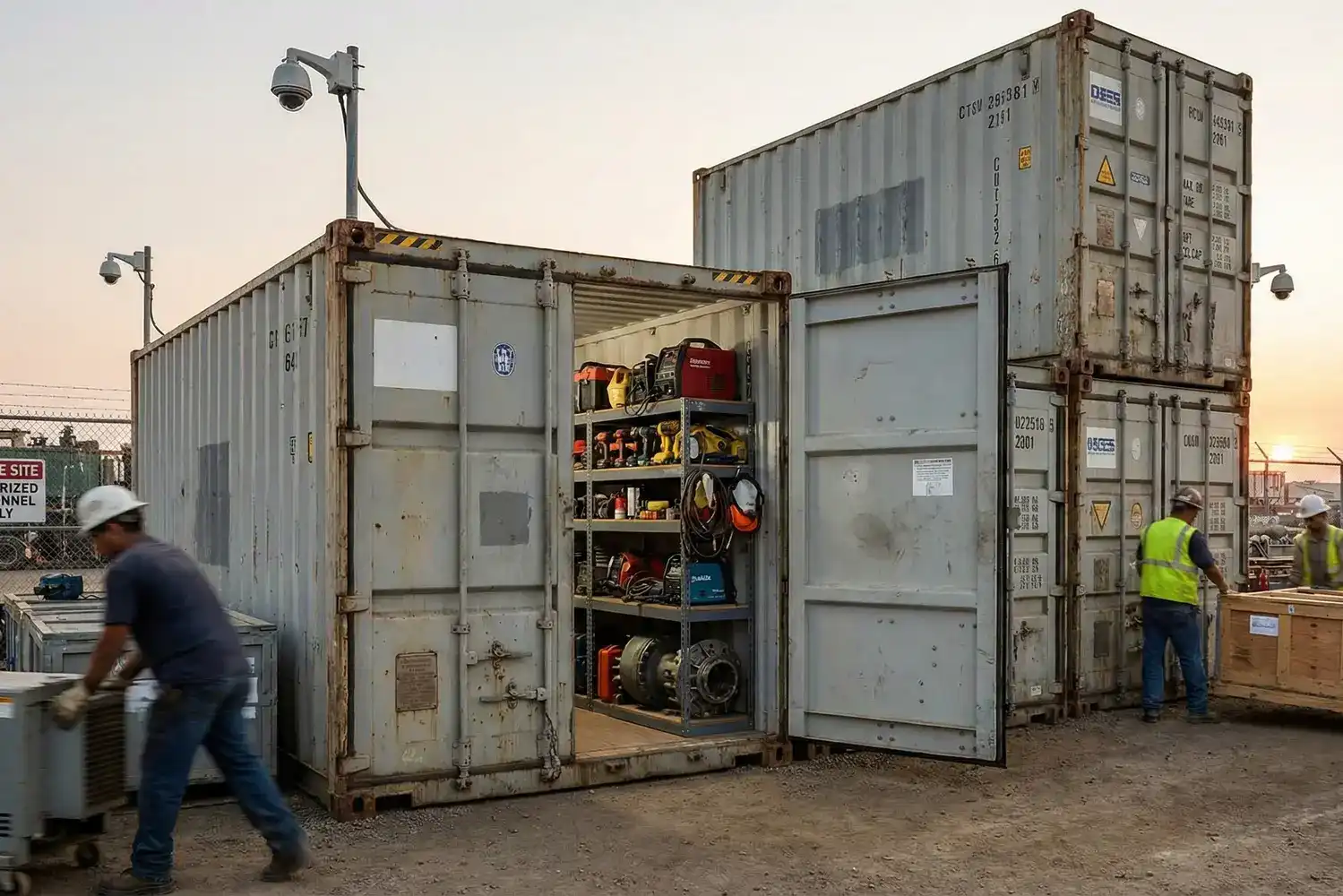
With reinforced steel doors, internal locking bars, and optional smart access systems, container-based storage significantly reduces risk.
Common security upgrades include:
- Anti-cut and anti-pry locks
- Steel lockboxes shielding padlocks
- Motion-sensor LED lighting
- CCTV and wireless monitoring systems
- Smart card or coded entry access
For businesses dealing with high theft potential—from copper coils to power tools to heavy machinery—these systems transform a container from a steel box into a fortified asset-protection solution.
Durability and Weather Resistance: Built to Withstand Harsh Environments
Shipping containers were originally designed to travel across oceans, stacked under extreme pressure, exposed to storms, saltwater, and temperature fluctuations. Repurposed as heavy-duty storage units, they offer unmatched durability.
Features industrial users rely on include:
- Secure weather-sealed doors
- Thick marine-grade steel walls
- Rust-resistant paint coatings
- Optional insulation and ventilation
From freezing northern regions to humid coastal climates and desert heat, containers perform reliably year after year—with minimal maintenance.
Customization Options for Different Industries and Storage Needs
Secure storage isn’t one-size-fits-all. A mechanic storing diagnostic machines has different needs than a welding team storing oxygen tanks, or a construction crew storing power tools and scaffolding.
That’s why container storage for equipment can be tailored with modifications such as:
- Built-in shelving and pegboard tool walls
- Forklift-safe reinforced flooring
- Ventilation systems for fumes or temperature regulation
- Multi-tier interior racking for equipment organization
- Partition walls to separate high-value items
This level of customization ensures every container supports workflow rather than simply holding items. What begins as a simple storage unit becomes an operational asset.
Portable Storage for Industries Working on the Move
For companies with shifting job locations—railroad contractors, utility crews, renewable energy teams, pipeline operations, and emergency response organizations—mobility isn’t optional. It’s essential.
Portable storage for industries makes it possible to:
- Transport equipment from site to site
- Keep tools secure during moves
- Store heavy machinery close to the work zone
- Reduce downtime searching or transporting items
The ability to relocate a storage unit means operations remain efficient even in remote or temporary locations.
Tool Storage Containers: Organization That Improves Productivity
In many industries, time wasted looking for tools—especially specialty equipment—creates measurable losses. Organized tool storage containers solve that problem.
Interior layouts can include:
- Labelled compartments
- Power-ready charging bays for battery-powered tools
- Sliding racks for hoses, wiring, or welding leads
- Cabinets locked inside the container for high-value items
This organization reduces fatigue, improves workflow, and ensures every tool has a designated place to return to after use.
Short-Term and Long-Term Storage Flexibility
Companies often need storage solutions that adapt to different stages of work, seasons, or staffing changes. Permanent brick structures limit flexibility, but containers can be leased, relocated, expanded, or converted for new purposes.
Use cases include:
- Temporary on-site project storage
- Off-season equipment storage
- Overflow inventory capacity during peak production
- Long-term fixed operation storage solutions
This makes container storage solutions a long-term investment with short-term adaptability.
Cost Efficiency: Why Containers Make Financial Sense
When comparing containers to permanent buildings or warehouse rentals, the financial advantages are clear. Containers eliminate many traditional cost points:
- No architectural planning required for basic use
- No long construction delays
- No additional roof, wall, or structural fabrication
- Low maintenance requirements over decades
For many industrial operations, this isn’t just about affordability—it’s about predictable, controlled cost planning.
Safety Compliance and Hazard-Sensitive Storage
In industries working with chemicals, fuels, gas cylinders, or heat-producing equipment, safety compliance is mandatory.
Containers can be modified to meet requirements such as:
- Ventilation for hazardous materials
- Fire-resistant insulation
- Spill containment flooring
- Emergency exit installations
These features transform a standard unit into a compliance-aligned secure storage space suitable for regulated goods.
Scalability: Expand Storage Capacity as Operations Grow
Industrial growth usually means more equipment. With traditional structures, increasing storage capacity requires building expansions or relocation. With containers, expansion is simple:
- Add additional units
- Stack vertically where permitted
- Connect containers through converted door openings
Containers function as modular building blocks—allowing businesses to scale without disruption.
Real-World Industrial Uses for Secure Storage Containers
Today, industrial storage containers can be found across multiple sectors:
- Construction companies storing power tools and materials
- Oil and gas operations storing pipeline equipment
- Mining companies storing heavy machinery replacement parts
- Municipalities storing road, electrical, or fleet maintenance supplies
- Electrical contractors housing wiring, transformers, and generators
- Logistics hubs storing seasonal or overflow inventory
Their adaptability is one reason demand keeps rising.
Preparing a Site: What’s Needed Before Delivery
Unlike permanent buildings, secure storage containers rarely require complicated preparation. Most installations only need:
- Level ground (gravel, pavement, or concrete preferred)
- Proper drainage to avoid pooling water
- Clearance for delivery equipment
Once placed, they’re ready to use immediately or can undergo on-site modification if needed.
Maintenance Requirements: Built Strong with Minimal Upkeep
One of the biggest benefits of steel container storage is how little maintenance it requires.
Recommended care includes:
- Inspect seals and paint annually
- Monitor moisture control systems
- Keep locks lubricated and secure
- Ensure proper airflow for stored equipment
With these basic steps, containers remain reliable for decades of industrial use.
Environmental Benefits: A More Sustainable Approach to Industrial Storage
Beyond durability and security, container storage solutions also offer environmental advantages compared to constructing new storage buildings from scratch. Repurposing shipping containers keeps large quantities of steel out of landfills and reduces demand for new construction materials such as lumber, cement, and insulation—materials that carry high environmental production costs.
When adapted as secure storage containers, these repurposed units become long-term solutions rather than disposable infrastructure. Their lifecycle can extend 30 to 50+ years, and because they are modular, they can be repurposed again if operational needs change—from tool storage to office space, or even combined into larger modular structures.
Sustainable modifications—like solar-powered lighting, low-VOC insulation, and passive ventilation—further decrease energy consumption. In industrial environments working toward carbon reduction goals, choosing containers isn’t just practical—it signals commitment to responsible resource use and lower-impact infrastructure.
Secure Storage That Supports Operational Momentum
In industries where equipment equals productivity, securing tools, machinery, and materials isn’t just good practice—it’s essential. Secure storage containers offer unmatched durability, mobility, and customization, making them one of the smartest long-term storage solutions available today.
They protect investments.
They simplify operations.
They move when the work moves.
And most importantly—they ensure the job never slows down simply because equipment isn’t protected, stored correctly, or available when it’s needed.