

Condensation and poor insulation are two of the most common problems owners run into after a shipping container lands on site. Both show up as water inside the container, which is why they get mistaken for a leaking roof or a failed door seal. In most cases, the steel is sound, and the water came out of the air that was sealed inside the box.
This guide explains why a shipping container sweats, how hot one gets in the sun, and the three methods that stop condensation. It also compares five insulation methods on R-value and cost, so you can match the fix to what the container actually holds.
Why Does a Shipping Container Sweat Inside?
A shipping container sweats when warm, damp air inside the box touches steel that has cooled below the point where water forms. Air holds a set amount of water, and warmer air holds more of it, so cooling that air forces the moisture back out. Once the moisture leaves the air, it settles on whatever surface inside the container happens to be coldest.
In a shipping container, the coldest surface is almost always the roof, because steel holds very little heat. After sunset, the roof loses its warmth to the sky within minutes, while the cargo below stays warm for hours. Water then collects on the underside of the roof, gathers into drops, and falls onto the load as container rain.
The same process happens on the side walls, although it produces less water because walls cool more slowly than the roof. Water forming on the walls and on goods stacked against them is known as container sweat rather than container rain. Both have the same cause, so both respond to the same three fixes covered below.
Where the Water Comes From
None of that water enters through the steel, since every drop was already inside the container before the doors were shut.
| Source | What it is | What it reaches first |
|---|---|---|
| The air sealed in at loading | Humid air trapped when the doors close | Ceiling and upper walls |
| The load itself | Timber, paper, produce and anything stored damp | Cardboard, labels, cartons |
| The wooden floor | Container decking that absorbs and releases moisture | Pallet bases and lower cartons |
| Worn door seals | Door gaskets that have hardened, split or flattened | Floor and the door end |
Of the four sources, the load does most of the damage, because damp cargo keeps releasing moisture every time the air warms up. Packing wet pallets or damp cardboard gives the container a water supply that feeds the problem for as long as it sits there.
What Gets Damaged First
Condensation ruins soft and absorbent materials long before it does anything visible to the steel shell around them. Most storage claims come from the first two items below rather than from rust, which takes considerably longer to appear.
- Cardboard and paper packaging, which soften and collapse under a stacked load
- Fabric, upholstery and anything stored inside soft cases
- Labels and printed cartons, which lift and stain until stock cannot be sold
- Tools, fixings and bare steel, which take on surface rust
How to Tell Condensation From a Leak
Condensation and a leak both leave you with wet cargo, so the pattern of water on the floor is what separates them. A leak soaks one area directly beneath the damaged panel, while the rest of the container floor stays dry.
Condensation instead wets the whole ceiling evenly, leaving drip marks spread across the top of the load below. Check the container on a dry morning after a cold night, because water inside after two dry days is always condensation.
How Hot Does a Shipping Container Get Inside?
A shipping container standing in direct sun gets far hotter inside than the outside air temperature would suggest. The Transport Information Service published measurements showing a dark-painted container reaching 122°F on a day when outside air sat at 77°F. A white container under the same sun reached 100°F, which shows how much paint color changes the result.
That heat matters because warm air carries more moisture, and anything damp inside releases vapor into it through the afternoon. When the sun drops and the steel cools, the air can no longer hold that moisture, so it condenses on the ceiling. Spring and autumn therefore cause more trouble than high summer, since a wide day-to-night swing produces more water than steady heat.
How to Stop Condensation in a Shipping Container
Three methods stop condensation in a shipping container, and each one attacks a different part of the same problem. You can dry the air with desiccant, move the air with vents, or keep the steel warm with insulation. A fourth option, climate control, holds both temperature and humidity using powered equipment rather than passive materials.
The table below compares all four, so you can match the method to what the container holds and how long it stays.
| Method | What it does | Use it for | Watch out for |
|---|---|---|---|
| Ventilation | Swaps inside air for outside air | Dry climates and ambient storage | Humid outside air makes it worse |
| Desiccant | Pulls water out of sealed air | Sealed storage and transit | Runs out and needs replacing |
| Insulation | Keeps steel above the condensing point | Long storage and workspaces | Highest cost, takes interior space |
| Climate control | Holds a set temperature and humidity | Stock that cannot tolerate swing | Needs power and a sealed unit |
Most sites end up using two methods together rather than relying on one, because each covers a gap the other leaves. A storage container standing in a yard runs well on vents and desiccant, while a working office needs insulation and climate control.
Start With Ventilation
Ventilation is the cheapest fix and the first one worth trying, since it costs nothing to run once installed. Vents let damp air escape and draw drier outside air in, which lowers the humidity inside without any power supply.
Standard containers arrive with small vents near the top rail, although those are sized for pressure rather than for moisture. Most storage jobs therefore need more airflow than the factory fittings provide, especially in a container packed close to the roof.
Ventilation only helps while outside air is drier than the air inside the container. Through a humid coastal summer, venting pulls more water in than it lets out, so vents alone will not solve the problem. Our guide to types of shipping container vents covers formats, placement, and how many a container of each size needs.
Add Desiccant on Top
Desiccant handles the moisture that ventilation cannot reach, which makes it the natural partner to a vented container. Hang it before the doors close, and it absorbs water from the air for weeks, so the steel never reaches the condensing point.
Vents and desiccant together cover most storage jobs, and insulation only becomes necessary once people or sensitive stock are involved.
Shipping Container Desiccant: What to Use and How Much
Desiccant, sold as a shipping container moisture absorber, pulls water vapor out of sealed air before condensation can start. It offers the best value of any fix for a container that stays closed for weeks at a time.
Bags, Strips, Poles and Blankets
Four formats cover almost every job, and the right one depends on where water forms and how the load is stacked.
| Format | Where it goes | Best for |
|---|---|---|
| Hanging strips and poles | Clipped to the lashing rings along the top rail | Loaded containers in storage or transit |
| Bags and pouches | On pallets or tucked between cartons | Smaller loads and spot protection |
| Blankets and liners | Over the load or against the walls | Stock that cannot take any damp |
| Floor pads | Under pallets on the deck | Containers standing on damp ground |
Hanging formats earn their place because the ceiling is where water forms first, so an absorber up high catches it at the source.
How Much Desiccant a Container Needs
Three factors set the quantity, and container size is the least important of the three. Wet cargo needs far more desiccant than dry cargo, since the moisture it releases has to be absorbed as well. Doors that open daily need more than a sealed unit, and six months of storage needs more than six weeks.
Buy to the capacity printed on the pack rather than to a rule of thumb, because absorption varies between products. Set a reminder to check it, since desiccant that saturated weeks ago is doing nothing at all for your cargo.
When Desiccant Is Not Enough
Desiccant stops working in three situations, and all three come up regularly on a working site.
- Doors open every day, so fresh damp air replaces whatever the desiccant absorbed
- Storage runs long and the desiccant saturates with nobody there to swap it
- The load needs a held temperature rather than simply dry air
Where any of those three apply, insulation or climate control does the job that desiccant on its own cannot.
How to Insulate a Shipping Container: 5 Methods Compared
Insulating a shipping container keeps the inner face of the steel warm enough that water never forms on it. That is a different goal from heating a room, and it changes which material makes sense on a corrugated wall. The table below uses R-values and installed costs published by the US Department of Energy.
| Method | R-value | Cost per sq ft | Interior space lost |
|---|---|---|---|
| Closed-cell spray foam, 1 inch | R-6.5 | $1.30 to $2.00 | Least |
| Polyisocyanurate board, 1 inch | R-6.5 | $0.60 to $0.70 | Moderate |
| Extruded polystyrene board, 1 inch | R-5.0 | $0.40 to $0.55 | Moderate |
| Expanded polystyrene board, 1 inch | R-3.8 to R-4.4 | $0.20 to $0.35 | Moderate |
| Fiberglass batt, 3.5 inches | R-13 | $0.20 to $0.40 | Most |
Spray foam and polyisocyanurate board both reach R-6.5 per inch, although foam costs two to three times more per square foot. That gap is worth paying on a corrugated wall, and harder to justify once a frame is going in anyway.
Which Insulation Method Should You Pick?
Match the method to the job rather than to the price, since the cheapest option often costs more to put right later. Choose spray foam for a container being converted into a workspace, where corrugation makes board awkward and the vapor barrier matters.
Choose rigid board or an insulation kit for storage or a self-build, because it delivers most of the benefit for a third of the cost. Skip insulation altogether where the container holds tools and pallets through a dry season, and spend the money on vents and desiccant instead.
Closed-Cell Spray Foam
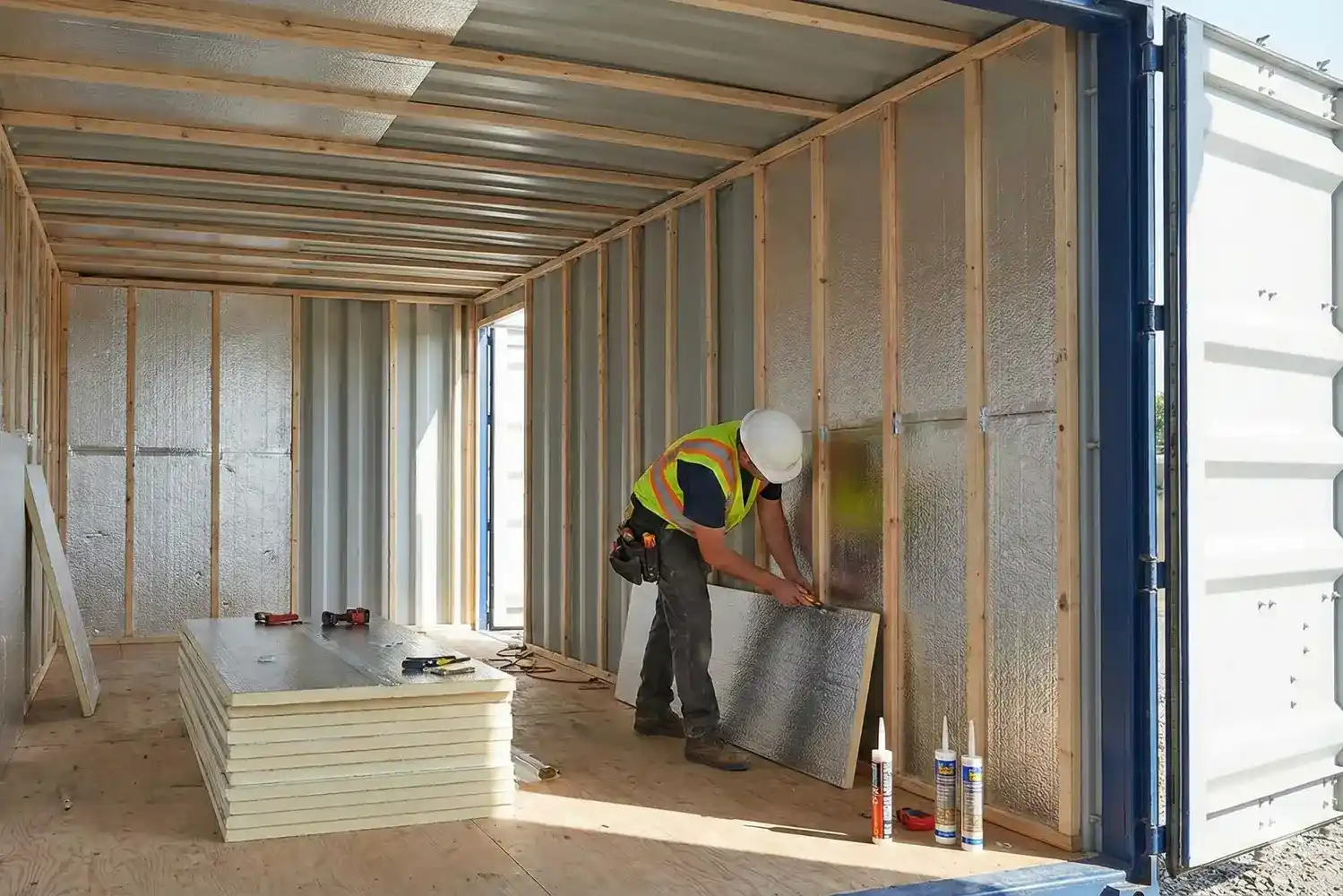
Spray foam insulation is the default choice for containers because it bonds straight to the corrugation with no air gap behind it. Without that gap, water can’t form on a cold surface, so one application handles condensation and heat loss.
Spray foam is also the most expensive option and needs a contractor with the right equipment on site. Foam has to be covered with a fire barrier once applied, and a foamed container is harder to sell on afterward.
Rigid Foam Board and Insulation Kits
Rigid board is the budget route, and the one most owners can fit themselves over a weekend. Insulation panels and kits arrive cut to size, go up quickly, and cost well under half what spray foam does per square foot.
Board will not bend to corrugation, so it needs furring strips or a light frame to sit against. Every seam and screw hole becomes a path to cold steel, which is why taping and sealing all of them matters. A rushed board job traps damp behind the panel, hiding the problem rather than fixing it.
Fiberglass Batt
Fiberglass batt is the cheapest material on the list and the poorest fit for a shipping container. Batt cannot touch the steel, so a stud frame goes in first and takes interior width you cannot really spare.
A container gives you 7 feet 8 inches wall to wall, as listed on our 20ft shipping containers for rent page. Framing both sides removes a noticeable slice of that, and batt also soaks up water once it gets damp.
Insulating Paint and Thermal Blankets
Insulating paint and thermal blankets are not insulation, whatever the packaging on either product suggests. Both reduce radiant heat on the shell, which helps a little under summer sun but does nothing through a cold night.
Neither carries an R-value you can compare against the five methods above, so use them alongside insulation rather than instead of it.
Where to Insulate: Walls, Roof, Floor and the Outside
Start with the roof, because that is where water forms and where the drips onto your load begin. Roof insulation therefore returns more for the same money than wall insulation does, with walls second and the floor last.
Does the Floor Need Insulating?
A container floor rarely needs insulating for plain storage, since the deck sits on the corner castings with air beneath it. That air gap keeps the floor warmer than the roof, so condensation forms overhead long before it forms underfoot.
Insulate the floor where people stand on it all day, or where the container sits directly on a concrete slab. Our guide to preparing your site before installing a shipping container covers slab and gravel bases in more detail.
Insulating the Outside Instead of the Inside
Exterior insulation keeps all 7 feet 8 inches of interior width, which matters in a container that narrow. It also moves the cold surface to the outer face of the steel, so nothing condenses inside the container at all.
The drawback is cost, because cladding and weather trim have to go over the insulation once it is fixed. Exterior work therefore suits a container being converted, while interior insulation is enough for one holding pallets.
Where the Vapor Barrier Goes
A vapor barrier belongs on the warm side of the insulation, and on one side only. Fitting a barrier to both faces traps damp inside the build-up with no way out, which rots the frame over time. Closed-cell spray foam removes the decision entirely, since the foam acts as its own barrier once cured.
What Does It Cost to Insulate a Shipping Container?
Shipping container insulation runs between $0.20 and $2.00 per square foot for materials and labor, depending on the method chosen. Spray foam sits at the top of that range and rigid board at the bottom, using the Department of Energy figures above. Four factors move the final bill, and the method you pick is only the first of them.
- Method, which sets the base rate per square foot
- Size, since a 40ft unit has roughly twice the surface area of a 20ft
- Scope, because framing, cladding, and finishing are separate jobs from insulating
- Access, since spray foam needs a contractor on site and board does not
Those are house rates rather than container rates, so get a local quote before you set a budget for the job.
Insulate a Used Container or Start With an Insulated One
Two routes lead to an insulated container, and they suit different buyers rather than different budgets. Insulating a used container yourself works when you want a specific build and have time to book the trades.
Starting with a finished unit works when the container has to be usable the week it arrives on site. Our shipping container modifications guide covers what a modified unit includes before it leaves the yard.
Insulated and Climate Controlled Containers
Insulated and climate-controlled get used as if they mean the same thing, although the difference is significant. An insulated shipping container slows the temperature swing down, while a climate-controlled container holds a temperature and humidity you set. Insulation alone buys a gentler swing and more time, so stock that must stay at a number needs powered equipment.
Climate control also costs more to run, because it draws power every hour the container sits on site. Work out whether your stock needs a held temperature or only needs to stay dry, since dry is far cheaper to achieve.
Refrigerated Containers
A refrigerated container holds a setpoint rather than merely slowing the swing, which suits stock with a fixed temperature range. CMG refrigerated containers for rent run from -13°F to +77°F on a three-phase supply, so one unit covers chilled and frozen.
Insulation and machinery take up interior space, so a 20ft reefer holds 999 cubic feet against 1,170 in a dry 20ft.
Office Containers
Where people work inside the container, starting with a unit built for occupation saves the whole insulation exercise. CMG office containers for rent arrive with R-13 polyurethane SIP walls already fitted and wired.
Each unit lands with air conditioning and heat, rated at 9,000 BTU in the 20ft and 12,000 BTU in the 40ft. That is the same R-13 as an insulated stud wall, without the frame, the trades or the vapor barrier decision.
Moisture Control Checklist Before You Load
Seven steps cut the risk of condensation before the doors close, and each one costs almost nothing to follow.
- Set the container on ground that drains, so wet soil is not feeding moisture into the floor
- Load dry goods only, since damp cargo is the single biggest source of container rain
- Leave a gap between the load and the walls so air can move around the stack
- Keep cartons off the deck on pallets or dunnage rather than directly on the floor
- Hang desiccant before you close up, instead of after you find a problem
- Check the door seals for splits, hardening and flat spots along the gasket
- Open the container on a dry day rather than a wet one wherever possible
Our storage containers for rent page covers sizes and rental terms for units that stay on site for months.
Shipping Container Condensation and Insulation FAQs
Do shipping containers sweat?
Yes, and almost every container does at some point, because warm damp air inside meets steel that has cooled overnight. Water forms on the ceiling first and then drips onto whatever is stacked below it.
Are shipping containers insulated?
A standard shipping container has no insulation at all, which leaves bare steel as the surface where water forms. CMG office containers come with R-13 SIP walls, while refrigerated containers carry insulation rated to hold -13°F to +77°F.
Can you insulate a shipping container from the outside?
Yes, and exterior insulation keeps all 7 feet 8 inches of interior width inside the container. It costs more than interior work, because cladding and weather trim have to go over the insulation afterward.
What is the cheapest way to insulate a shipping container?
Expanded polystyrene board and fiberglass batt both start near $0.20 per square foot in the Department of Energy figures. Spray foam starts at $1.30 per square foot, which makes rigid board the cheaper route for most container jobs.
Does desiccant stop condensation on its own?
Inside a sealed container, desiccant stops condensation until it saturates and stops absorbing any further moisture. Daily door opening, long storage, or a load needing a held temperature all require a second method alongside it.
What R-value does a shippbing container need?
The right R-value depends on your climate zone and on what the container holds through the year. CMG office containers ship with R-13 walls, which matches the figure used for a standard insulated stud wall.
Does anti-condensation paint work?
Anti-condensation paint helps a little by cutting radiant heat on the shell, although it is not insulation. It carries no comparable R-value, so it will not stop condensation through a winter on its own.
Is a sweating container the same as a leaking container?
No, and the two need different fixes, because a sweating container makes water from the air sealed inside it. A leaking container lets water in, and our guide on whether shipping containers are watertight covers seals and door wear.