

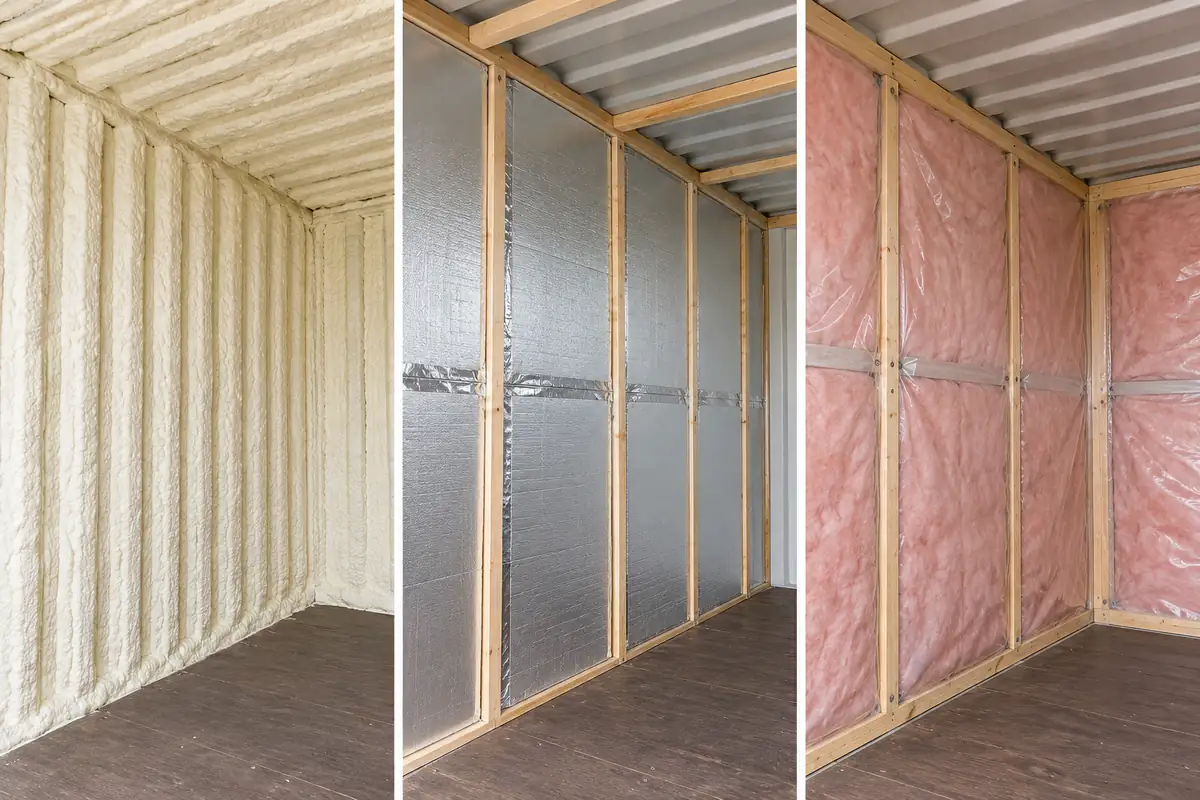
To insulate a shipping container, choose one of three methods (closed-cell spray foam, rigid insulation panels or blanket insulation), control moisture, and cover the walls, roof, floor and doors as one system. Bare corrugated steel moves heat in and out fast. In summer, an unlined container heats up quickly in direct sun. In winter, warm air inside meets cold steel and condenses into water that runs down the walls and drips from the roof.
The right method depends on how the container is used, the local climate and how much of the work you plan to do yourself. The sections below compare the three methods on vapor control, cost order and installation effort, then cover thickness, step order and the jobs a professional installer does better.
Why Insulating a Shipping Container Matters
Insulating a shipping container slows heat transfer through the steel shell and reduces condensation on the inside surfaces. Corten steel is an excellent structural material and a poor thermal barrier. Heat passes through the walls and roof quickly, so the interior temperature follows the weather outside.
Condensation is the bigger problem for most owners. Warm, moist air inside the container touches steel that is colder than the air’s dew point. The moisture in that air turns into droplets on the ceiling and walls. Owners call this container “sweat.”
Condensation causes three kinds of damage:
- Wet goods: water drips onto boxes, tools, furniture, paperwork and stored stock.
- Rust: moisture sits on the steel and starts corrosion from the inside.
- Mold and odor: damp cardboard, wood and fabric grow mold in closed, humid space.
A container is built to keep rain out, which also means it holds moisture in. Learn more about how airtight shipping containers really are. Insulation works together with vapor control and ventilation. Insulation alone does not stop condensation if moist air still reaches cold steel.
Insulation for Shipping Containers: The Three Main Options
Insulation for shipping containers falls into three main groups: closed-cell spray foam, rigid insulation panels and blanket (batt) insulation. Each method handles heat and moisture in a different way. The table compares the three methods on vapor control, cost order, DIY difficulty and best use.
| Method | Vapor control | Cost order | DIY difficulty | Best for |
| Closed-cell spray foam | Built in | Highest | Professional only | Humid sites, offices, full sealing |
| Rigid insulation panels | Needs sealed seams | Middle | Moderate | Workshops, DIY builds |
| Blanket (batt) | Needs separate barrier | Lowest material cost | Moderate | Dry climates, framed interiors |
Spray foam solves heat and moisture in one layer. Panels and batts depend on careful sealing to perform.
Spray Foam Insulation for Shipping Containers
Spray foam insulation for shipping containers is sprayed as a liquid that expands, fills the corrugations and cures into a solid layer bonded to the steel. Closed-cell foam is the type used on containers. The cured foam is dense, so it blocks air movement and acts as its own vapor barrier. Because no gap remains between the foam and the steel, warm moist air cannot reach the cold shell, which stops condensation at the steel surface.
Spray foam gives full coverage and airtight sealing, which makes it a strong choice for humid or coastal areas.
The trade-offs are cost and labor. Spray foam has the highest cost of the three methods, and application requires specialist equipment, protective gear and ventilation during curing. Spray foam is a job for a professional installer, not a weekend project.
Installers clean and prime the steel first, then spray the walls and the underside of the roof in layers until the foam reaches the target thickness. The cured foam can stay exposed in a storage container or sit behind interior panels in an office or workshop.
Insulation Panels for Shipping Containers
Insulation panels for shipping containers are rigid boards, such as rigid foam board or polyiso board, cut to size and fixed against the walls and ceiling. Insulated wall systems are another option: prefabricated panels that combine insulation and an interior finish in one product.
Shipping container insulation panels are flat, while container walls are corrugated. That shape leaves air pockets behind each board. Installers handle the gap in one of two ways:
- Build a stud frame inside the container and fit the panels between the studs.
- Fix the panels directly to the steel and fill the corrugation gaps with foam sealant.
The seams between panels are the weak point. Every joint needs tape or sealant, because moist air that slips through a seam condenses on the steel behind the board. Panels sit in the middle of the cost range and suit owners who want to do part of the work themselves.
Blanket (Batt) Insulation
Blanket insulation, also called batt insulation, comes in rolls or pre-cut pieces of fiberglass or mineral wool. Installers press the batts between the studs of a timber or metal frame built inside the container, then close the wall with plywood or drywall.
Batts have the lowest material cost of the three methods and are easy to buy. The weakness is moisture. Fiberglass and mineral wool let air and vapor pass straight through. Without a continuous vapor barrier on the warm side of the wall, moist air reaches the steel, condenses and soaks the batts. Wet batts lose much of their insulating value, sag inside the wall and start to smell.
A sealed vapor barrier, with taped seams and sealed edges, is not optional on a container insulated with batts. The method suits dry climates and owners who already plan a full framed interior.
What Is the Cheapest Way to Insulate a Shipping Container?
The cheapest way to insulate a shipping container is blanket insulation inside a stud frame, sealed with a continuous vapor barrier. Batts have the lowest material cost per square foot. Rigid panels fixed directly to the walls come second and save the cost of a full frame on smaller projects.
Material cost is only part of the total. Three other factors change the real price:
- Labor: batts and panels need framing, cutting, sealing and an interior finish. Spray foam needs no framing to perform, although most finished interiors still add one for wall panels.
- Moisture risk: a cheap wall that traps condensation behind the batts costs more to tear out and redo than a correctly sealed wall.
- Lost space: a stud frame takes interior width that spray foam does not.
For storage that only needs protection from extreme heat and condensation, panels on the walls and roof are often the most cost-effective middle ground. For an office or living space in a humid area, spray foam often justifies its higher upfront cost, because one layer handles both heat and moisture.
How Do You Insulate a Shipping Container? Step by Step
You insulate a shipping container in seven steps, working from the steel shell inward:
- Clean and treat the steel. Remove dirt and grease, sand any rust spots and apply a rust-inhibiting primer.
- Plan openings first. Cut and frame windows, vents and doors before insulating, so no finished work is damaged later.
- Build the frame. Fix studs to the walls and ceiling if you use batts or framed panels.
- Insulate the roof. The ceiling is where condensation drips onto contents, so treat the roof as the first priority.
- Insulate the walls and seal the vapor control. Fit the panels or batts, then tape every seam or install the vapor barrier.
- Insulate the floor. Add rigid board under a new subfloor, or insulate the underside of the container if it is raised.
- Seal the doors and gaps. Close gaps around the cargo doors and service penetrations.
Keep ventilation in the plan. An insulated container still needs air exchange to clear moisture from people, equipment and stored goods. See the main types of shipping container vents before you close up the walls. How to insulate a shipping container well comes down to this order: shell, openings, roof, walls, floor, then gaps.
How Thick Should Insulation for a Shipping Container Be?
Insulation for a shipping container should be as thick as the use requires and no thicker, because every inch comes out of the interior space. A standard 20ft or 40ft container has an internal width of about 7 ft 8 in. Two insulated walls with framing and an interior finish reduce that width further, which matters in an office or living space.
Match the thickness to the use:
- Dry storage: a thin layer on the roof and walls reduces condensation and cuts heat gain.
- Workshop or site cabin: a medium layer on walls, roof and floor keeps the space workable through the seasons.
- Office or living space: full coverage with the highest practical insulating value, plus heating and cooling.
Most container homes use between 2 and 4 inches of insulation. Spray foam generally reaches the target performance with less thickness than batts, which helps in a narrow container.
A factory-insulated office container shows what a finished office spec looks like. CMG office containers, for example, use SIP panel walls with R-13 polyurethane insulation and an air conditioner with heat: 9,000 BTU on a 20ft unit and 12,000 BTU on a 40ft unit.
Insulating It Yourself vs Hiring a Professional
Insulating a container yourself saves labor cost, but it takes time, tools and careful sealing. Rigid panels and batts are realistic DIY jobs for owners who can build a stud frame, cut boards accurately and tape every seam. A small storage container or garden workshop is a good first project.
Some parts of the job belong to a professional:
- Spray foam: a trained installer with spray equipment handles the whole application.
- New openings: cutting windows, vents or doors into the steel changes the structure.
- Electrical and HVAC: wiring and climate control inside an insulated wall need qualified installers.
A third route skips the build entirely: a container that leaves the factory already insulated, with interior walls, heating and cooling in place.
If you would rather hand the job over, CMG offers shipping container insulation services with spray foam or thermal panels, plus soundproofing.
Frequently Asked Questions
How do you stop condensation in a shipping container?
You stop condensation in a shipping container by keeping warm, moist air away from cold steel. Closed-cell spray foam or a sealed vapor barrier blocks that contact. Vents then clear moisture from inside. Insulation without vapor control often moves the condensation behind the wall instead of stopping it.
Can you insulate a shipping container?
Yes, any steel shipping container can be insulated with spray foam, rigid panels or blanket insulation. Owners insulate storage units, workshops, offices and homes, and insulation can be added to a new or used container before the interior is finished.
What is the best way to insulate a shipping container?
The best way to insulate a shipping container depends on climate and use. Closed-cell spray foam performs best in humid or coastal areas because it seals the steel and controls vapor in one layer. Rigid panels suit DIY workshops. Batts work only with a fully sealed vapor barrier.
How much does it cost to insulate a shipping container?
The cost to insulate a shipping container depends on the method, the container size, whether the roof and floor are included and the interior finish. Spray foam costs the most, panels sit in the middle and batts cost the least in materials. Installers usually quote each project after confirming the container size and scope.
How do you soundproof a shipping container?
You soundproof a shipping container by adding mass and absorption to the walls. Common options are acoustic foam or acoustic wall panels, mass-loaded vinyl barriers and layered insulated wall systems. Combining these layers reduces both outside noise coming in and sound leaving the container.