
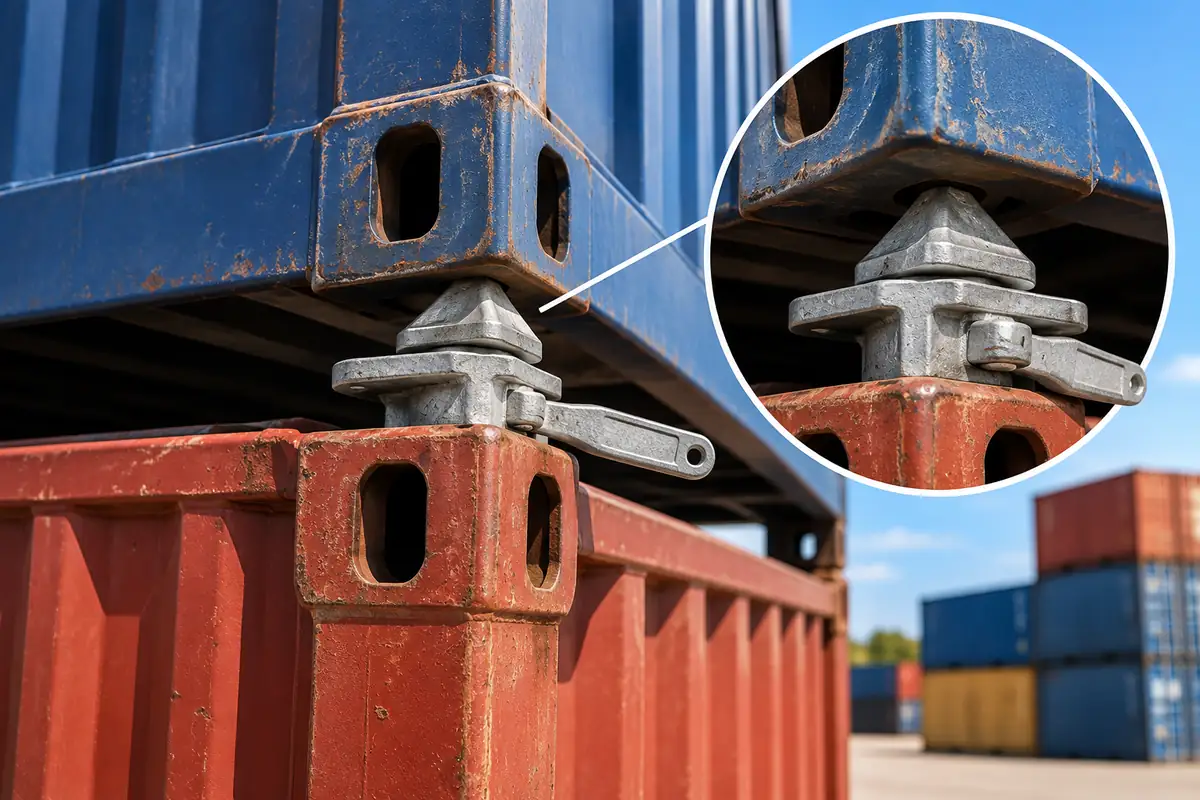
Every shipping container has eight corner castings, one at each corner, built to connect the container to other containers, trucks, ships and foundations. A shipping container twist lock is the fitting that joins two of those castings together. Twist locks connect containers vertically when they are stacked. Side connectors and bridge fittings tie containers together side by side.
The same hardware that holds containers on a cargo ship also holds containers together on a job site, at an event or in a multi-unit building. On land, the rules are different from the rules at sea: the ground has to be level, the lifting has to be done with the right equipment, and any stacked or joined structure that people occupy needs an engineer’s input and often a permit. The sections below explain each fitting, how stacking and joining work, and where the limits sit.
What Is a Shipping Container Twist Lock?
A shipping container twist lock is a steel connector with a cone-shaped head that fits into the oval hole of a corner casting and rotates a quarter turn to lock in place. Once turned, the head cannot pull back out of the casting, so the two connected parts move as one unit.
Twist locks connect containers to each other in a stack, to truck chassis and rail cars, and to ground plates on a foundation. They are a standard part of intermodal shipping, which is why the corner castings on every container are the same shape and size.
A twist lock is not a security lock. A twist lock holds a container in position; it does not stop anyone from opening the cargo doors. Door security relies on a different set of hardware, explained in our guide to the shipping container lock box. Twist locks also appear in CMG’s list of must-have shipping container accessories.
Corner Castings: Where Twist Locks Connect
Corner castings are the hollow, reinforced steel blocks welded into the eight corners of a container frame. Each casting has oval openings on its top or bottom face and on its sides. Those openings accept twist locks, stacking cones, lifting hooks and lashing equipment.
Corner castings carry the weight of the container and everything stacked above it. That is why every connection, whether to another container, a truck or a foundation, goes through the castings rather than through the walls or roof. The walls and roof panels are not designed to carry point loads from another container.
Before joining or stacking, check that every casting is undamaged, free of heavy rust and clear of debris, so each twist lock seats fully.
Manual vs Semi-Automatic Twist Locks
Manual twist locks have a lever or handle on the side. A worker places the twist lock in the casting, sets the upper container on top, then turns the handle to lock both cones. To release the connection, the worker turns the handle back. Manual twist locks suit site work, storage yards and fixed installations, because they are simple, visible and easy to check.
Semi-automatic twist locks lock themselves when the upper container lands on them and are released by pulling a cord or lever. Fully automatic twist locks lock and release without anyone touching them. Semi-automatic and fully automatic types are built for speed in ports and on ships, where cranes load and unload thousands of containers. For a site project with two or three units, manual twist locks give more control.
Shipping Container Side Twist Locks and Bridge Fittings
Shipping container side twist locks connect two containers placed side by side through the corner castings on their long sides. A common side connector is a double cone, sometimes called a horizontal twist lock, which fits into the side openings of two neighboring castings at the same time.
Bridge fittings, also called bridge clamps, join the top corner castings of two neighboring containers. A bridge fitting is a steel bar with a hook or pin at each end and a tensioning screw in the middle. Tightening the screw pulls the two containers together and holds them in line.
A typical side-by-side connection uses both:
- Bottom corners: side connectors or ground plates keep the base of each container aligned.
- Top corners: bridge fittings pull the tops together and stop the containers from separating.
Together, these fittings let two or more containers act as one wider block, which is the starting point for a double wide setup.
How to Stack Shipping Containers Safely
You stack shipping containers safely by preparing a level base, lifting with proper equipment, and locking every corner casting before releasing the load. The process follows six steps:
- Prepare the base. The bottom container needs a firm, level foundation. Review the shipping container foundation options first.
- Place the bottom container. Check that all four corners sit level.
- Insert the twist locks. Fit a twist lock or stacking cone into each top corner casting of the bottom container.
- Lift the upper container. Use a crane or other lifting equipment rated for the load, attached to the corner castings.
- Lower and align. Guide the upper container down so each bottom casting lands on a cone.
- Lock and check. Turn every manual twist lock to the locked position and confirm all four corners are engaged.
Lifting a container is professional work. A container weighs thousands of pounds empty, and a lift that goes wrong causes serious injury. Hire a qualified crane operator and rigger for every stack.
Which Locks Hold a Stack Together
Shipping container locks for stacking come in two main forms: twist locks and stacking cones. A twist lock rotates and locks the two castings together. A stacking cone, sometimes called a stacker, only locates the upper container on the lower one and keeps it from sliding sideways, without locking it.
On land, use twist locks for any stack that stays in place. Twist locks hold the containers together when wind or ground movement pushes on the stack, while a stacking cone only stops sideways sliding. Stacking cones suit short-term yard storage, where containers are moved often and crews unstack them regularly.
Never leave stacked containers resting on each other without connectors. Check every twist lock after storms and before moving any unit, and replace any twist lock with a bent cone, a cracked body or a handle that no longer holds the locked position.
How High Can You Stack Shipping Containers?
How high you can stack shipping containers depends on each container’s rated stacking strength, the condition of the frame and the site conditions. Every container approved for international transport carries a CSC safety approval plate, usually on the door. The plate states the allowable stacking weight the container frame is rated to carry.
Stacking heights on cargo ships and in port terminals use specialized equipment, engineered lashing and trained crews. Stacking on a job site, at an event or in a building is far more conservative. Wind exposure, ground strength and the absence of lashing systems all reduce what is safe on land.
Loaded and empty containers behave differently. A loaded container puts much more weight on the containers and the ground below it, while an empty container catches wind more easily relative to its weight. CMG’s container event structures include stacked containers used as stages.
For any stack beyond a simple two-high storage setup, or any stack that people will occupy, have an engineer confirm the design.
How to Join Two Shipping Containers Into a Double Wide
You join two shipping containers into a double wide by placing them side by side on a shared level foundation, connecting them with side connectors and bridge fittings, sealing the seam, and, for one open interior, cutting out the shared walls with structural reinforcement.
Start with matching containers. A double wide shipping container setup works best with two units of the same length and the same height. A standard container and a high cube container differ in height, so the roofs will not line up. One-trip containers suit visible builds such as offices and homes, because the steel and paint are in better condition.
The joining process has five stages:
- Build a shared foundation that keeps both containers level with each other.
- Place the containers tight together, aligned end to end.
- Connect the castings with side connectors at the bottom and bridge fittings at the top.
- Seal the seam along the roof and walls so rain cannot enter the gap.
- Open the interior by removing the shared side walls, if a single wide room is the goal.
The last step changes the structure. Container side walls contribute to the strength of the box, so removing them requires steel framing to replace the lost support. That work belongs in professional container modifications, not in a DIY project. Double wide shipping containers built this way serve as offices, workshops, classrooms and living spaces.
When You Need an Engineer and a Permit
You need an engineer when containers are stacked, joined with walls removed, or used as an occupied space such as an office, classroom or home. An engineer checks the loads on the corner castings, the reinforcement around cut openings, the foundation and the connections between units.
A permit is often required for the same structures. Building departments treat an occupied, permanent or multi-unit container structure as a building, which brings in rules for structure, exits, electrical work and fire protection. Requirements vary by town and county, so contact the local building department before buying or modifying containers. Read more about planning permission for container projects.
Larger multi-unit projects often work better as purpose-designed modular buildings.
Frequently Asked Questions
How do twist locks work?
A twist lock works by fitting a cone into the oval hole of a corner casting and rotating it a quarter turn so it cannot pull out. Manual twist locks turn with a handle. Semi-automatic and automatic twist locks lock when a container lands on them.
How are shipping containers connected?
Shipping containers are connected through their corner castings. Twist locks or stacking cones connect containers vertically in a stack. Side connectors and bridge fittings connect containers side by side. The walls and roof are not used as connection points.
Can a twist lock connect two containers side by side?
A standard twist lock connects containers vertically. Side-by-side connections use side connectors, also called double cones or horizontal twist locks, at the bottom corners and bridge fittings at the top corners.
When should you use twist locks on containers?
Use twist locks whenever containers are stacked, joined, or fixed to a foundation with ground plates. Twist locks help keep containers from sliding or lifting in wind. Stacked containers should never rest on each other without connectors.
Can office containers be stacked?
Yes, some office containers are designed to stack. CMG’s office and storage combo units can be kept stacked on top of one another. See the office and storage combo containers for specifications and sizes.