
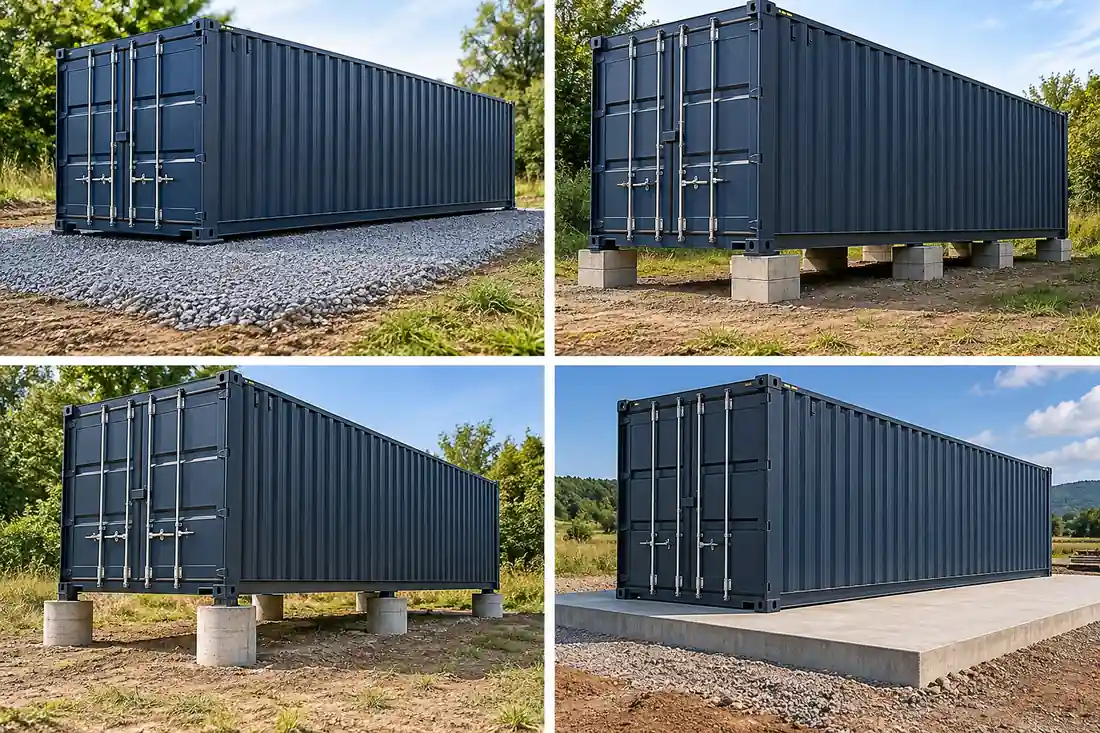
A shipping container sits on its four corner castings, so a foundation for a shipping container has to hold those four points level, firm and dry. For a short or medium-term rental, compacted, level and well-drained ground is usually enough. For a container that stays in place for years, or one converted into an office, workshop or home, a planned foundation protects the frame, the floor and the doors.
There are four common foundation types: a gravel pad, concrete blocks, concrete piers and a concrete slab. Each one suits a different combination of soil, climate, budget and length of stay. The sections below explain how a container carries its weight, compare the four options side by side, and cover frost, drainage, anchoring and what a delivery truck needs on site. If you are still preparing the ground, start with how to prepare your site before delivery.
Does a Shipping Container Need a Foundation?
A shipping container does not always need a foundation, but it always needs level, firm and well-drained ground. The answer depends on how long the container stays and what it is used for.
For a rental, a foundation is usually unnecessary. Rental units such as storage containers for rent are placed directly on level, firm ground with no groundwork, and a 20ft container needs about one parking bay of space.
For a permanent or long-term placement, a foundation becomes the better choice. Four problems appear when a container sits on poor ground for years:
- Sinking: soft soil settles under the corners, and the container tilts.
- Binding doors: a twisted frame pulls the cargo doors out of line, so the doors stop closing or sealing properly.
- Trapped water: rain pools under the floor and around the doors.
- Rust: steel in constant contact with wet ground corrodes faster.
A foundation lifts the container slightly, spreads the load and lets water drain away. The type you need depends on soil, frost, budget and how permanent the setup is.
Corner Castings, Level Ground and When Leveling Feet Help
A container carries its weight through the four corner castings and the bottom side rails, not through the middle of the floor. The corner castings are the reinforced steel blocks at each corner of the frame, and they are the points that touch the ground or the foundation.
The loads are large. A 20ft container has a tare weight of 4,850 lb and a maximum payload of 62,150 lb. Read more on how much a shipping container weighs by size and type. When one corner sits lower than the others, the frame twists slightly. The first sign is usually a cargo door that drags or will not latch.
Leveling feet and shims correct small differences in ground height. Leveling feet are adjustable supports placed under the corner castings, and they work well on ground that is firm but slightly uneven. Leveling feet do not fix soft soil, steep slopes or poor drainage. Those conditions call for a proper base.
Shipping Container Foundation Ideas: 4 Options Compared
Four common shipping container foundation ideas are a gravel pad, concrete blocks, concrete piers and a concrete slab. The table compares them on the points that decide most projects.
| Foundation | Best for | Rental or permanent | Cost order | Effort | Drainage |
| Gravel pad | Storage, long rentals | Both | Low | Low to medium | Excellent |
| Concrete blocks | Quick, level support | Both | Lowest | Low | Good if raised |
| Concrete piers | Uneven or soft sites | Permanent | Medium | Medium to high | Good |
| Concrete slab | Offices, workshops, homes | Permanent | Highest | High | Depends on grading |
Gravel and blocks suit flexible setups. Piers and slabs suit permanent ones.
Gravel Pad for a Shipping Container
A gravel pad for a shipping container is a layer of crushed stone, compacted in lifts and leveled, sized slightly larger than the container footprint. A 20ft container covers 160 sq ft of ground and a 40ft container covers 320 sq ft, so the pad extends a little past those dimensions on every side.
Gravel spreads the load across a wide area and drains water quickly, which keeps the floor and bottom rails dry. A gravel pad also gives the delivery driver a firm, level surface to unload onto.
A gravel pad suits storage containers, long-term rentals and sites where a permanent concrete base is not allowed or not worth the cost. Compaction is the key step. Loose gravel shifts and settles under a loaded corner, so the pad needs firm, compacted layers rather than a single loose spread of stone.
Concrete Blocks for a Shipping Container Foundation
Concrete blocks for a shipping container foundation are solid blocks placed under each corner casting, plus additional blocks at the midpoints of the bottom rails on longer units such as a 40ft container. Shipping container foundation blocks are a fast, low-cost way to raise a container off the ground.
Blocks only work on firm ground. Each block carries a concentrated load, so a block resting on soft or uneven soil sinks and throws the container out of level. Blocks are often set on compacted gravel or a small concrete pad.
Use solid blocks, not hollow cinder blocks, and check that every block sits level with its neighbors. Loose, improvised blocking, such as stacked bricks or scrap timber, can let a container shift and jam its doors. Concrete blocks for shipping container use work well for semi-permanent setups that may move later.
Concrete Piers for a Shipping Container
Concrete piers for a shipping container are columns of concrete set into the ground under each corner, and often under the midpoints of the side rails. Piers can be poured on site into dug holes or forms, or installed as precast concrete footings for shipping containers.
A pier foundation for a shipping container reaches below the soft surface soil into firmer ground. That makes piers a strong option on sloped, uneven or soft sites where a slab would need large amounts of fill. Piers also keep the container well above the ground, which helps airflow and drainage.
Pier spacing and depth depend on the soil, the container size and the load. A site professional or engineer sets those dimensions for a permanent structure. Piers suit container offices, workshops and homes that stay in one place.
Concrete Slab for a Shipping Container
A concrete slab for a shipping container is a continuous reinforced concrete pad poured under the full footprint. A shipping container concrete foundation of this type is the most permanent and the most expensive option.
A slab gives the most uniform support and a clean, level surface for modified containers, such as offices, workshops, garages and living spaces. A slab also simplifies utility connections, because conduits for power and water can be placed in the concrete before it is poured.
A concrete foundation for a shipping container needs proper grading so water runs away from the slab edges and the cargo doors. Permanent slabs are more likely to need a permit than temporary bases, so check with the local building department before pouring.
Concrete Footings, Frost Line and Drainage
Concrete footings for a shipping container must account for frost and water, because both move the ground under a container. In cold-winter areas, water in the soil freezes and expands. That movement, called frost heave, lifts footings that sit too shallow and drops them again when the ground thaws.
The frost line is the depth to which the ground freezes in a typical winter. Footings for permanent structures are set below that depth. The frost line depth is set by local building codes and differs widely between regions, so the local building department is the correct source for your site. Sites in the Northeast face very different frost conditions than sites in Florida or Texas.
Drainage matters on every site, cold or warm. Grade the ground so water flows away from the container. Keep water from pooling at the base or in front of the cargo doors. Gravel around footings and piers helps rain soak away instead of collecting under the floor.
How to Anchor a Shipping Container to the Ground
You anchor a shipping container to the ground by connecting the corner castings to the foundation or to ground anchors, so wind cannot slide or lift the unit. An empty container presents a large flat side to the wind relative to its weight.
Anchoring matters most in high-wind areas, on exposed sites and for permanent installations such as offices and homes. Common methods include:
- Ground plates or weld plates set in concrete and connected to the corner castings.
- Twist locks that lock the corner castings to anchor points in the foundation.
- Shipping container tie down straps or cables attached to ground anchors.
The right method depends on the foundation type and local requirements. A temporary rental on level ground usually needs no anchoring. For permanent or exposed placements, ask the installer or a site professional which anchoring system fits the foundation.
Rental vs Permanent Placement: What Delivery Needs
Rental and permanent placements share one requirement: the delivery truck must reach the spot and set the container down on level, firm ground.
Containers are commonly delivered on a tilt-bed truck that slides the unit onto the ground. Clearance needs vary by supplier. As a reference, CMG’s tilt-bed deliveries need about 60 ft of straight-line clearance for a 20ft container and about 100 ft for a 40ft container, plus about 12 ft of width and 14 ft of overhead clearance. Check gates, turns, trees and overhead lines before delivery day. See more delivery access and placement tips for the truck route.
For a permanent unit, finish the foundation before the delivery date and confirm that the truck can reach it. If you plan to buy a container for a permanent base, the 20ft shipping containers for sale page lists new and used options.
Frequently Asked Questions
Can a shipping container sit directly on the ground?
Yes, a shipping container can sit directly on firm, level and well-drained ground, which is common for rental containers. For long-term use, a foundation such as gravel, blocks or piers protects the floor and frame from moisture and settling.
How many concrete blocks do you need for a shipping container?
A shipping container needs at least four concrete blocks, one under each corner casting. Longer units such as a 40ft container commonly add blocks at the midpoints of the side rails. Confirm the layout with a site professional for heavy loads or soft ground.
Is a gravel pad good enough for a shipping container?
A gravel pad is good enough for most storage containers and long-term rentals. The gravel must be compacted, level and graded so water drains away from the doors.
Do I need a permit for a shipping container foundation?
Permit rules depend on your town. Permanent foundations such as slabs and piers are more likely to need review than temporary bases. Read more about planning permission for a container and check with your local building department.